
What Is an American Curl Scottish Fold Cross, and Which Ear Gene Carries the Risk?
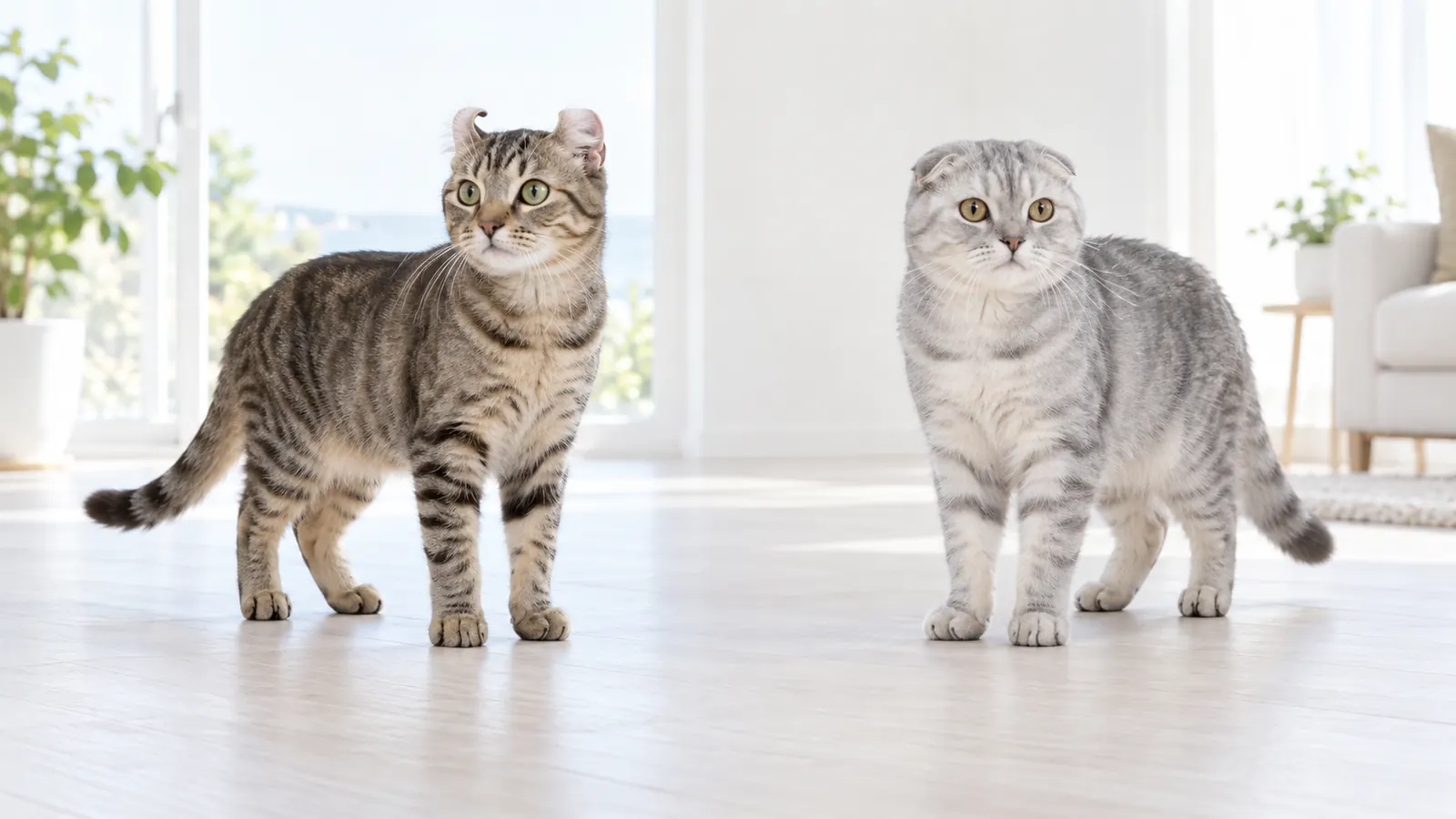
An American Curl Scottish Fold is a cross between two breeds whose ears come from different inherited traits: the Curl's ear bends backward and the Fold's folds forward. No registry recognises the combination. The fact that matters most is whether a kitten inherits the Scottish Fold variant, because that variant also causes osteochondrodysplasia, a painful disorder of cartilage and bone, and a curled ear does not show that a kitten escaped it.
- Origin
- No breed origin; an informal cross of the American Curl and the Scottish Fold
- Coat
- Depends on the individual parents; both breeds come in short and long coat varieties
- Size
- Medium; both parent breeds are medium-sized
- Typical weight
- No figure for the cross; the CFA American Curl standard gives about 2.3 to 3.6 kg for females and 3.2 to 4.5 kg for males
- Life expectancy
- No published figure; in a cat carrying the fold variant, the course of joint disease matters more than any breed range
- Activity level
- Variable; the American Curl is described as playful into adulthood, and joint disease can limit a cat that carries the fold variant
- Grooming
- Depends on the coat inherited: a Curl-type coat needs combing two or three times a month, a dense Fold-type coat a weekly comb and more in spring and autumn
- Suits
- No cross-specific evidence; the Curl is described as good with children and other pets, Folds can be reserved with other cats, and a cat with painful joints needs gentle handling
An American Curl Scottish Fold cross puts two different ear traits into one litter. No registry recognises it as a breed, and nobody has studied these cats as a group, so what is known about them comes from the two parent traits and from a small number of veterinary reports.
Only one of those traits carries a documented welfare problem. The Scottish Fold's folded ear comes from a variant that also damages cartilage and bone across the skeleton, while decades of American Curl breeding have reported no comparable disease from the curl.
How Do the Two Ear Genes Differ?
The American Curl carries a dominant gene (Cu) that curls the ear cartilage backward. The geneticists who studied the founding cats found the trait inherited as a dominant gene with no deformities attached, and CFA's breed profile reports that decades of Curl-to-Curl matings, including cats with two copies, produced no reported genetic abnormalities. That is breeding experience rather than a population health study, but it is a clear contrast with the Fold.
The Scottish Fold carries a dominant variant (Fd) that folds the ear cartilage forward. It is a change in the TRPV4 gene, and the same change causes osteochondrodysplasia, an inherited disorder of cartilage and bone that affects joints and the tail as well as the ear.
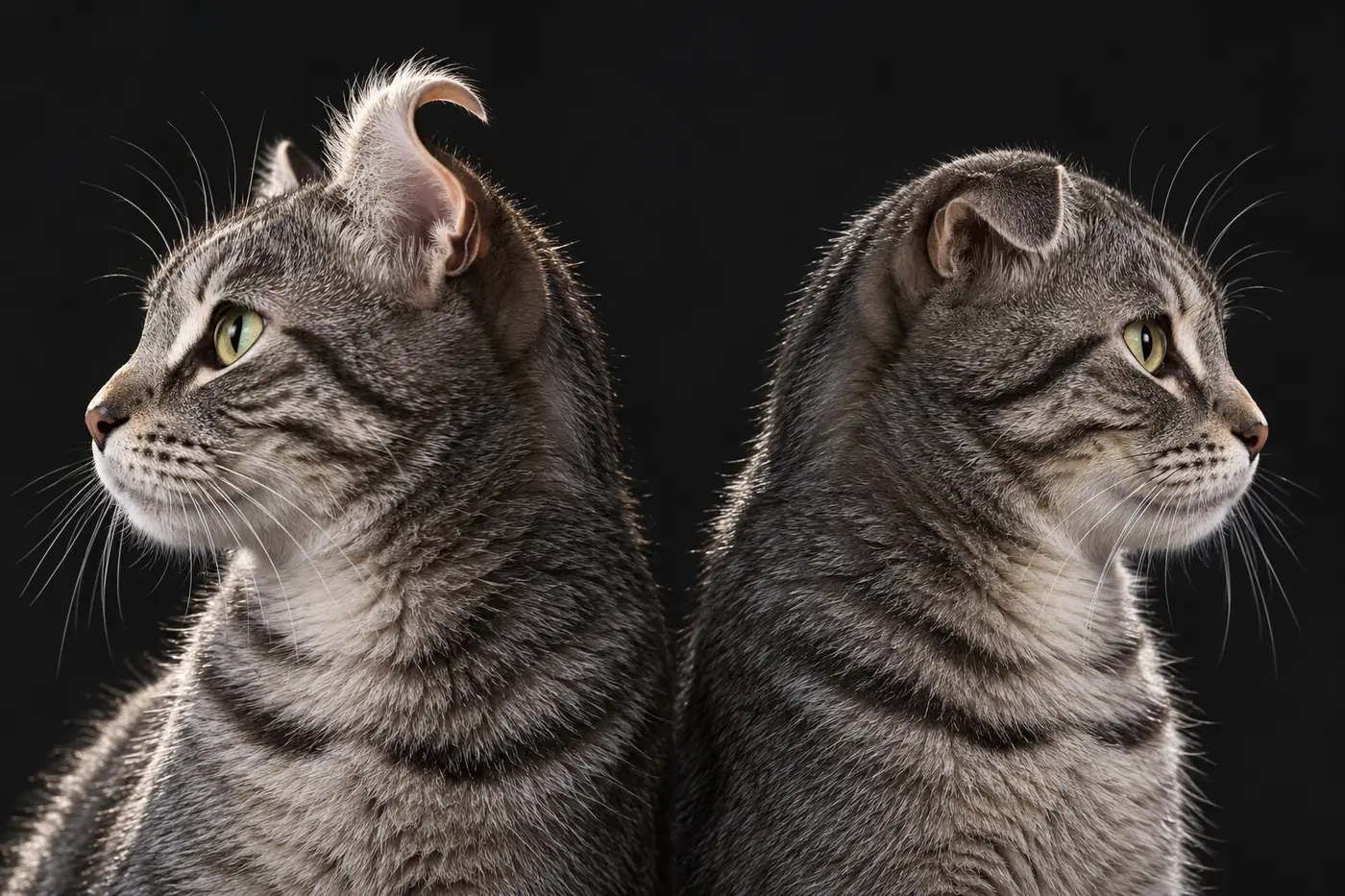
One copy is enough to cause disease. A Fold mated to a straight-eared cat passes on a single copy, and in a published series of ten affected Scottish Folds, every cat with pedigree information reportedly came from exactly that kind of mating. The severity, age of onset and progression varied from cat to cat, and the authors concluded that every Scottish Fold had the disorder to some degree. Two copies are linked to severe disease early in life.
| Gene | Ear direction | Cartilage disease | Skeletal welfare concern |
|---|---|---|---|
| Cu (American Curl) | Backward curl | None reported | None reported across decades of Curl breeding |
| Fd (Scottish Fold, TRPV4) | Forward fold | Osteochondrodysplasia | Yes, with one copy or two, and variable in severity |
Carrying the curl as well does not protect a cat that inherits the fold variant. The fold variant acts on cartilage throughout the body, and nothing reported about the curl trait suggests it changes that.
What Would a Cat With Both Genes Look Like?
Nobody can say from a photograph, and the one documented case shows why. In a 2020 Japanese report, a Scottish Fold and American Curl cross had ears that curled backward like an American Curl's. Genetic testing found two copies of the Scottish Fold variant, and radiographs at about a year old showed severe bony growths on its hind legs. Two copies means both of its parents carried the fold variant, even though the cat looked like a Curl.
The authors concluded that crossing Scottish Folds can produce appearances nobody can predict, and advised against it. For a buyer, that means a straight or curled ear on a kitten from this cross does not show whether it carries the fold variant. In a mating between a single-copy Fold and a Curl without Fold ancestry, about half the kittens would be expected to inherit it, and their ears may not say which half.
What Is an American Curl Scottish Fold Like to Live With?
There is no study of this cross, so size, character and lifespan can only be read from the parents and from the fold variant. Both parent breeds are medium-sized cats in shorthaired and longhaired forms. The CFA American Curl standard puts females at 5 to 8 pounds (about 2.3 to 3.6 kg) and males at 7 to 10 pounds (about 3.2 to 4.5 kg); the Scottish Fold standard describes a medium, rounded cat without giving weights.
The Cat Fanciers' Association breed profiles describe two different characters. The Curl is people-oriented, adaptable and chatty, and keeps a kitten-like playfulness into adulthood. The Fold is loving and calm, quiet without being placid, and happy to play fetch, and its profile adds that Folds do not do well left alone for long periods. These are breeders' descriptions of each breed rather than measured traits. A cross can take after either parent or neither, so nothing predicts an individual kitten's temperament.
On training, the Fold profile says Folds are intelligent enough to learn basic tricks, while the Curl profile calls the Curl intelligent and curious and says nothing about training. With other animals the two profiles differ. The Curl is described as respectful of other pets and compatible with dogs and other cats. Folds can be reserved with other cats, which may read the folded ears as a sign of hostility, so a fold-eared cross could meet the same misreading from cats already in the household. Both profiles describe their breed as good with children.
Grooming follows the coat each kitten inherits. The Curl coat is silky and flat with minimal undercoat, and CFA suggests combing it two or three times a month. The Fold's shorthair coat is dense and plush, sheds all year with heavier spells in spring and autumn, and needs a weekly comb. A cross with the denser Fold coat will shed more and need the more frequent routine.
The larger influence on daily life is whether the cat carries the fold variant. A cat with osteochondrodysplasia may become lame, stiff or reluctant to jump, at an age and severity nobody can predict. That cat needs low perches, a litter tray with a low entry it can step into without climbing, and handling that does not force its tail or hind legs, which matters most in a home with young children.
No lifespan figure exists for the cross. For a cat that carries the fold variant, the course of the joint disease will shape its later years more than any breed average.
Why Does No Registry Recognise This Cross?
The American Curl and the Scottish Fold are registered as separate breeds with separate standards, and a mating between them produces a cross-bred cat rather than either breed. No major registry lists the combination.
The welfare record also works against it. The German Animal Welfare Association reported in 2025 that Belgium, Austria and the Netherlands have banned the breeding of Scottish Folds by law, in some cases along with their sale or keeping. German animal welfare law already prohibits breeding animals when hereditary changes to their body parts or organs are expected to cause pain, suffering or damage. A cross that brings the fold variant into a litter raises exactly the problem those rules address.
Should You Acquire One?
On welfare grounds a cat that carries the fold variant is a poor choice: the joint disease it causes is painful, varies unpredictably and can start early. Because the ears cannot show which kittens from this cross carry the variant, the question has to be settled with evidence rather than by looking at the cat.
If the curled ear is the attraction, an American Curl from registered Curl lines gives you that on its own.
If you are considering a cat sold as this cross, these are the things that tell you something about it:
- A genotype result for the Scottish Fold variant (TRPV4 c.1024G>T), which settles whether the cat carries it
- Radiographs of the hind legs and tail, remembering that a clear result in a young kitten does not rule out later disease
- The ear type, movement and joint history of both parents, seen rather than described
- The rules on breeding and selling fold-eared cats where you live
Common Questions
Is an American Curl Scottish Fold a recognised breed?
No registry recognises this combination. It is a cross between two breeds whose ears come from different inherited traits.
Does the curl gene cancel the fold gene's health problems?
No. The Scottish Fold variant in TRPV4 causes osteochondrodysplasia whether or not the curl trait is present. A 2020 case report described a Fold and Curl cross with curled ears, two copies of the fold variant and severe bony growths on its hind legs.
What does osteochondrodysplasia do?
It is an inherited disorder of cartilage and bone. Reported signs include lameness, a stiff gait, reluctance to jump and a short, thick, inflexible tail, and the severity and age of onset vary between cats.
Are fold-ear crosses legal everywhere?
No. The German Animal Welfare Association reported in 2025 that Belgium, Austria and the Netherlands ban breeding Scottish Folds, and German law prohibits breeding when inherited changes to body parts are expected to cause pain, suffering or damage. Rules differ by country and change over time.
Checked Against
- CFA: The American Curl, a Balancing Act (breed profile) cfa.org
- Takanosu and Hattori: Osteochondrodysplasia in Scottish Fold cross-breed cats (J Vet Med Sci, 2020) pmc.ncbi.nlm.nih.gov
- Malik et al.: Osteochondrodysplasia in Scottish Fold cats (Aust Vet J, 1999) pubmed.ncbi.nlm.nih.gov
- German Animal Welfare Association: Lifelong suffering, why you should not buy a Scottish Fold (2025) tierschutzbund.de
- Tierschutzgesetz section 11b: breeding that causes suffering (German Animal Welfare Act) gesetze-im-internet.de
- CFA: American Curl breed profile and standard cfa.org
- CFA: Scottish Fold breed profile and standard cfa.org
Published 17 September 2026. Last updated .





